> ## Documentation Index
> Fetch the complete documentation index at: https://docs.membase.so/llms.txt
> Use this file to discover all available pages before exploring further.
# Attached vs Universal
> Understand why AI memory should be shared across agents, not isolated within individual tools. Learn the difference between attached and universal memory in Membase.
## Attached Memory
The AI agents you use every day, ChatGPT, Claude, Gemini, Cursor, and others, each have their own form of memory. But every one of them keeps that memory **isolated**.
What you told ChatGPT doesn't exist in Claude. Your Cursor project context is invisible to Gemini. Even within the same agent, switching sessions often means starting from scratch.
This is **attached memory**: memory that is bound to a specific agent, session, or tool.
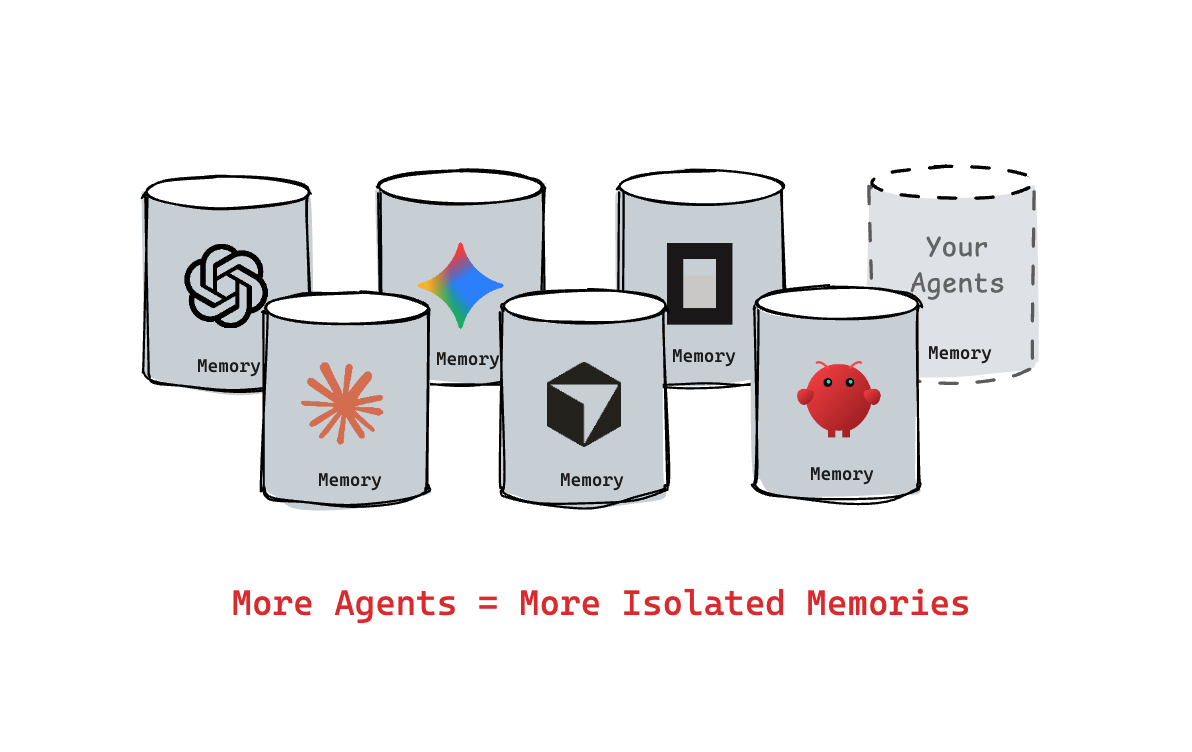
 This means:
* **You repeat yourself constantly.** Every new session, every new agent, you re-explain the same preferences and context.
* **Knowledge disappears.** When a session ends, valuable context is gone.
* **Agents contradict each other.** Different agents may have conflicting or outdated understanding of your preferences.
* **No cross-pollination.** A decision made in Claude never benefits your Cursor workflow.
## Universal Memory
**Universal memory** is a fundamentally different approach. Instead of each agent maintaining its own isolated memory, all your agents share a **single brain** that is persistent, automatically updated, and grows with you over time.
Membase takes this one step further: the universal knowledge layer has **two complementary stores**. **Memory** holds personal context (preferences, decisions, habits, meetings) as a knowledge graph. **Knowledge Wiki** holds factual, reference-style knowledge (docs, specs, stable notes) as linked markdown documents. Both stores are shared across every connected agent.
```mermaid theme={null}
graph TB
CH[ChatGPT] <--> M((Membase
This means:
* **You repeat yourself constantly.** Every new session, every new agent, you re-explain the same preferences and context.
* **Knowledge disappears.** When a session ends, valuable context is gone.
* **Agents contradict each other.** Different agents may have conflicting or outdated understanding of your preferences.
* **No cross-pollination.** A decision made in Claude never benefits your Cursor workflow.
## Universal Memory
**Universal memory** is a fundamentally different approach. Instead of each agent maintaining its own isolated memory, all your agents share a **single brain** that is persistent, automatically updated, and grows with you over time.
Membase takes this one step further: the universal knowledge layer has **two complementary stores**. **Memory** holds personal context (preferences, decisions, habits, meetings) as a knowledge graph. **Knowledge Wiki** holds factual, reference-style knowledge (docs, specs, stable notes) as linked markdown documents. Both stores are shared across every connected agent.
```mermaid theme={null}
graph TB
CH[ChatGPT] <--> M((Membase
Universal Memory))
CL[Claude] <--> M
GE[Gemini] <--> M
C[Cursor] <--> M
OC[OpenClaw] <--> M
M <--> GM[Gmail]
M <--> CAL[Calendar]
M <--> SL[Slack]
M <--> NO[Notion]
M <--> OB[Obsidian]
M <--> MD[Markdown]
style M fill:#09090B,stroke:#27272A,color:#fff
```
All agents read from and write to both stores. External data sources feed the right store: conversations and integrations such as Gmail, Calendar, and Slack build Memory, while Notion sync, Obsidian imports, Markdown imports, and factual documents build Wiki.
* **One brain, shared everywhere.** Tell one agent something, and every agent knows it. No silos, no repetition.
* **Two stores, one layer.** Personal context lives in Memory, factual knowledge lives in the Wiki, and agents can search both when a task benefits from them.
* **Permanent knowledge.** Context persists across sessions, days, weeks, and months. Nothing is lost when you close a tab.
* **Stays current where sources sync.** Conversations, synced emails, calendar events, Slack, and live Notion sources keep context current; one-time imports such as Obsidian and Markdown bootstrap the Wiki.
* **Grows with you.** The more you use your agents, the richer your knowledge graph and your wiki become. Your AI gets smarter over time, not just within a single session.
## Comparison
| | **Attached Memory** | **Universal Memory** |
| ----------------------- | ------------------------------------------- | ---------------------------------------- |
| **Scope** | Isolated per agent | Shared across all agents |
| **Persistence** | Lost between sessions | Permanent and growing |
| **Context setup** | Manual, repeated in every tool | Automatic from past interactions |
| **Cross-agent sharing** | None | Instant |
| **External data** | Manual setup per agent, if supported at all | Connected once, shared across all agents |
| **Consistency** | Agents may contradict each other | Single source of truth |
| **Growth** | Resets with each session | Compounds over time |
Membase doesn't replace your agents' built-in context features. It **augments** them with a shared, persistent layer that works across everything you use.
## Next Steps
Dive into the technical architecture.
Import chat history and connect apps to build your knowledge base.