

Attached Memory
The AI agents you use every day, ChatGPT, Claude, Gemini, Cursor, and others, each have their own form of memory. But every one of them keeps that memory isolated. What you told ChatGPT doesn’t exist in Claude. Your Cursor project context is invisible to Gemini. Even within the same agent, switching sessions often means starting from scratch. This is attached memory: memory that is bound to a specific agent, session, or tool.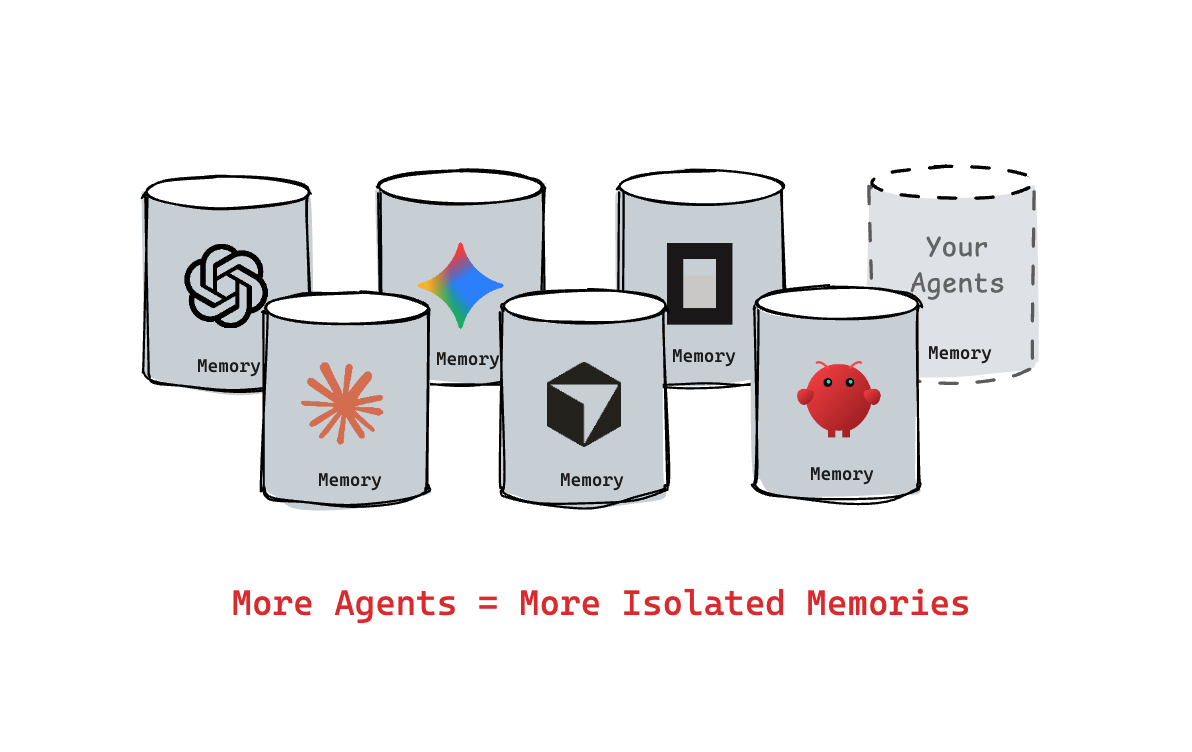
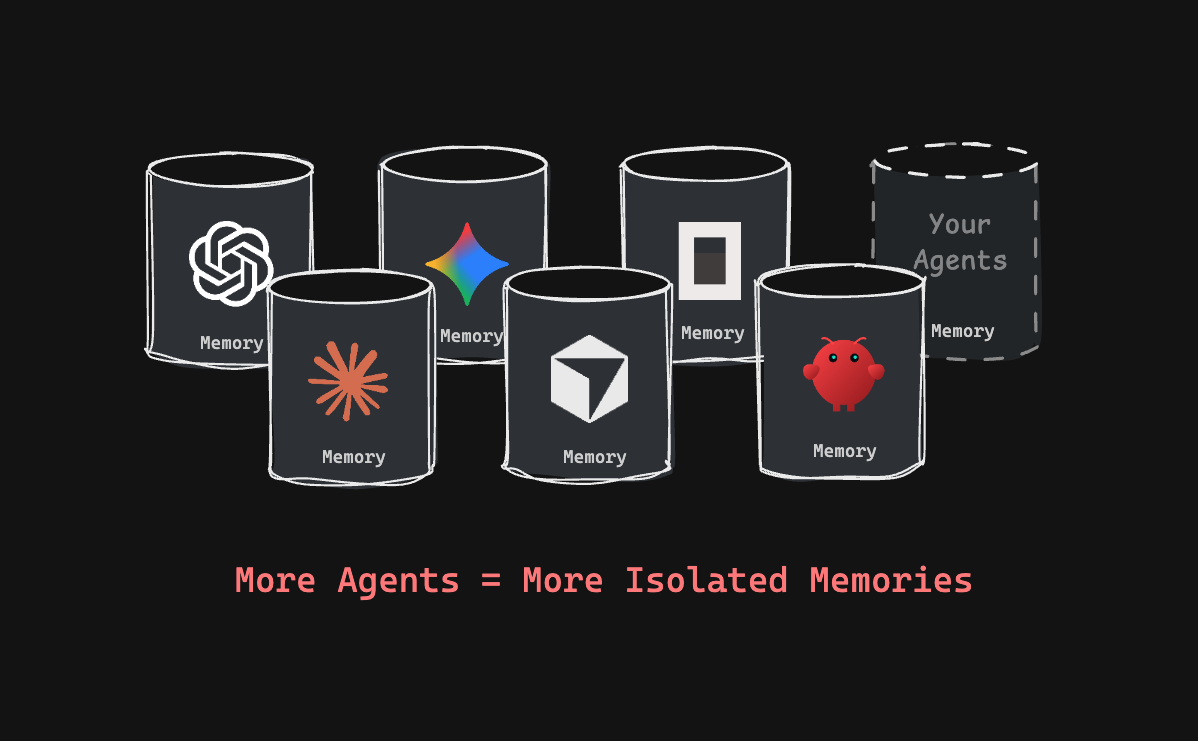
Each agent has its own isolated memory. None of them talk to each other.
- You repeat yourself constantly. Every new session, every new agent, you re-explain the same preferences and context.
- Knowledge disappears. When a session ends, valuable context is gone.
- Agents contradict each other. Different agents may have conflicting or outdated understanding of your preferences.
- No cross-pollination. A decision made in Claude never benefits your Cursor workflow.
Universal Memory
Universal memory is a fundamentally different approach. Instead of each agent maintaining its own isolated memory, all your agents share a single brain that is persistent, automatically updated, and grows with you over time. Membase takes this one step further: the universal knowledge layer has two complementary stores. Memory holds personal context (preferences, decisions, habits, meetings) as a knowledge graph. Knowledge Wiki holds factual, reference-style knowledge (docs, specs, stable notes) as linked markdown documents. Both stores are shared across every connected agent. All agents read from and write to both stores. External data sources feed the right store: conversations and integrations such as Gmail, Calendar, and Slack build Memory, while Notion sync, Obsidian imports, Markdown imports, and factual documents build Wiki.- One brain, shared everywhere. Tell one agent something, and every agent knows it. No silos, no repetition.
- Two stores, one layer. Personal context lives in Memory, factual knowledge lives in the Wiki, and agents can search both when a task benefits from them.
- Permanent knowledge. Context persists across sessions, days, weeks, and months. Nothing is lost when you close a tab.
- Stays current where sources sync. Conversations, synced emails, calendar events, Slack, and live Notion sources keep context current; one-time imports such as Obsidian and Markdown bootstrap the Wiki.
- Grows with you. The more you use your agents, the richer your knowledge graph and your wiki become. Your AI gets smarter over time, not just within a single session.
Comparison
Membase doesn’t replace your agents’ built-in context features. It augments them with a shared, persistent layer that works across everything you use.
Next Steps
How Membase Works
Dive into the technical architecture.
Bring Your Context
Import chat history and connect apps to build your knowledge base.